

Date:2026-06-13 Click:456
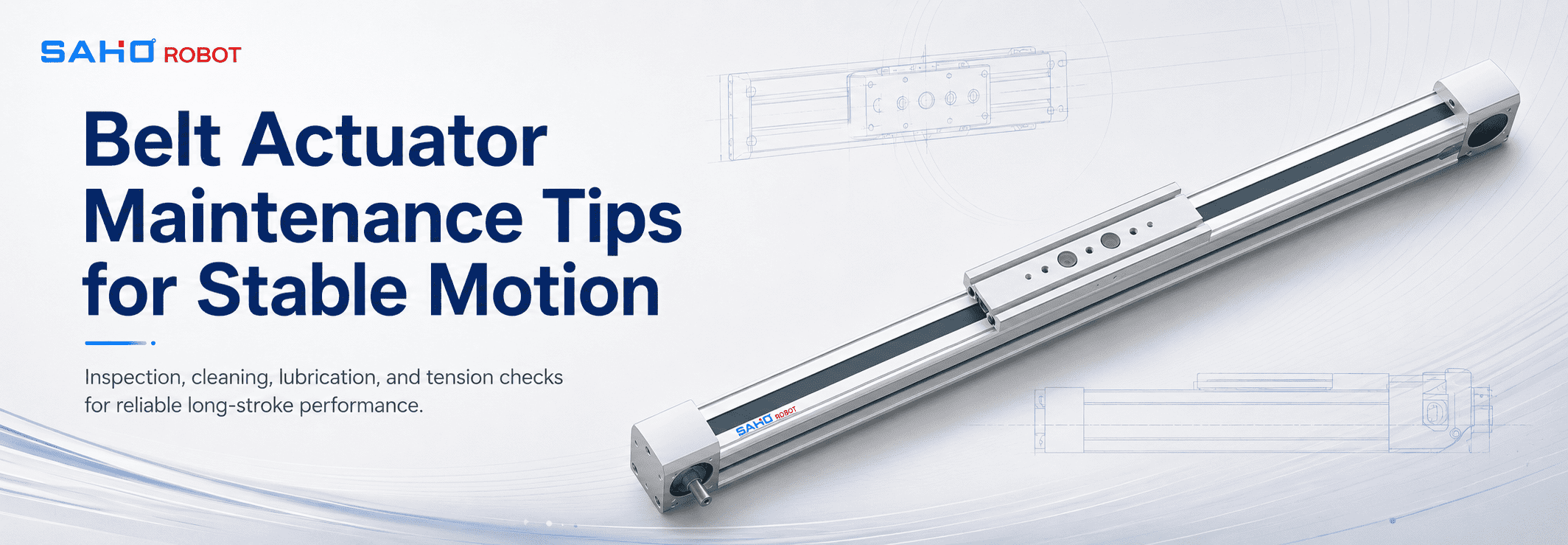
In long-stroke automation, a belt actuator supports fast travel, repeated movement, and stable positioning across extended machine layouts. However, reliable performance depends on more than choosing the first suitable model. It also depends on correct installation, clean operating conditions, suitable lubrication, stable belt tension, cable routing, and planned inspection.
Maintenance should be treated as part of belt-drive linear module design from the beginning. A finished module can reduce integration work, but it still needs a rigid base, clean carriage movement, correct motor matching, and practical service access. This article explains how to select, install, inspect, and maintain belt-drive modules for long-stroke automation systems.
Why Stable Long-Stroke Motion Matters in Automation
Long-stroke automation appears in transfer stations, loading systems, inspection equipment, packaging lines, laser machines, and multi-axis handling systems. These applications need an axis that can move across a long distance without unstable vibration. At the same time, the motion must remain repeatable during daily production.
A tray transfer system, for example, may move parts between two workstations hundreds or thousands of times per shift. If the axis shakes or settles slowly at the end position, the whole machine cycle becomes less predictable. In inspection equipment, unstable travel may affect camera positioning, image quality, and measurement consistency.
Packaging automation often combines long travel with frequent start-stop movement. A belt-drive module can support this motion pattern when the payload, stroke, acceleration, and mounting layout are suitable. However, poor tension, dirty moving paths, or cable drag can quickly change a smooth axis into a noisy and unstable one.
Stable long-stroke motion depends on a complete system. The linear module, frame, motor, sensor, cable routing, tool bracket, and maintenance plan all affect final operation. For this reason, product selection and maintenance planning should be considered together.
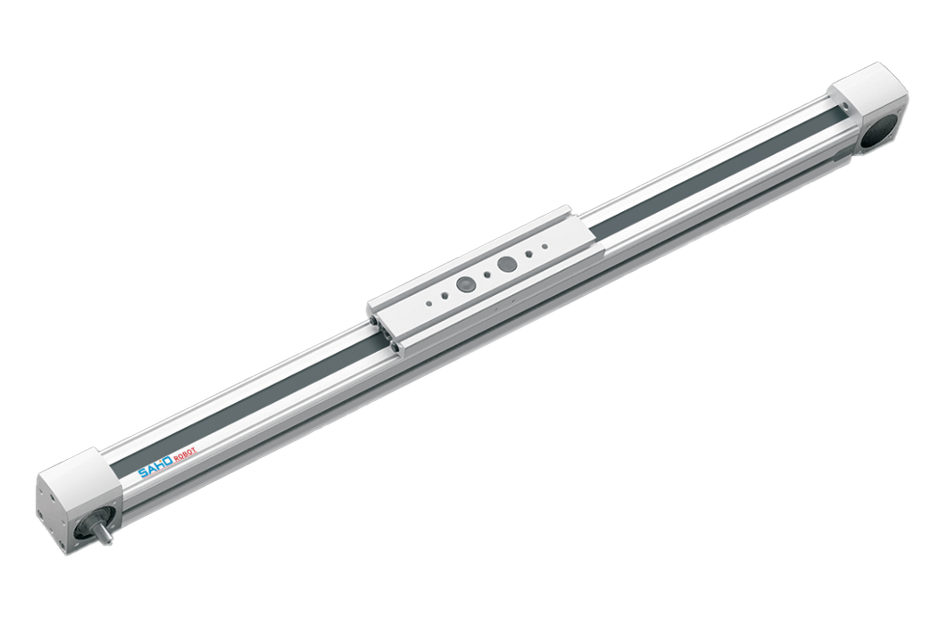
TA Series: suitable for high-speed belt-driven transfer layouts where stroke length, machine space, and repeatable movement need a balanced structure.
Application Benefits of Belt-Drive Linear Modules
A belt-drive linear module is useful when an automation system needs speed and travel distance at the same time. The timing belt and pulley structure can move the carriage efficiently over longer strokes, so it is commonly used for transfer, feeding, scanning, loading, and positioning tasks.
Compared with many compact screw-driven layouts, belt-drive modules are often easier to apply in long-travel movement. The structure helps avoid some limitations that appear when a screw becomes very long. As a result, belt-drive modules are often selected for horizontal transfer and fast repeated travel.
Another benefit is layout flexibility. A finished module includes the main body, carriage, belt drive, end blocks, bearing support, and mounting interfaces. This allows the engineering team to focus on machine layout, tooling, control logic, and safety instead of building an axis from separate transmission parts.
A belt-drive module is not a universal answer for every motion task. Very high rigidity, high thrust, or very fine positioning may require another drive structure. The application should be judged by stroke, payload, speed, repeatability, installation direction, and working environment, not by product name alone.
Where Belt-Drive Modules Fit Best
Belt-drive modules fit applications that require long travel and moderate to high speed. Common examples include material transfer, light gantry movement, camera scanning, tray loading, packaging movement, label handling, and process feeding. In these cases, the axis often needs to repeat the same motion path many times.
In electronics assembly, the module may move a camera, dispenser, test head, or fixture. The working area may be compact and sensitive to vibration, so stable acceleration, clean stopping, and suitable carriage support are important.
In laser-related equipment, the module may support marking, cutting assistance, inspection movement, or loading and unloading tasks. Laser stations may create smoke, fine particles, or thermal residue, so contamination control and cleaning access should be considered from the beginning.
In packaging and logistics equipment, belt-drive modules can support repeated transfer between stations. Paper dust, film fragments, and adhesive residue can affect long-term operation, so routine cleaning should be built into the operating plan.
In solar, battery, and panel-related automation, long-axis movement may support inspection or material handling. These applications often require wide travel and smooth positioning, so frame alignment and cable movement should be reviewed carefully.
Maintenance Value: Preventing Small Problems From Becoming Downtime
Maintenance helps protect stable motion before visible failure appears. Belt tension, pulley condition, carriage movement, lubrication, mounting bolts, cable routing, and noise behavior should be checked regularly. These small checks can prevent larger production interruptions.
A smooth axis usually has a consistent sound and movement feel. If the sound changes suddenly, the maintenance record can help locate the cause faster. A clicking sound near the end block may suggest debris, belt tooth damage, or loose fastening. A rubbing sound may suggest alignment stress or contamination near the moving path.
Vibration is another important sign. If vibration appears only during acceleration, the cause may involve the motion profile, payload moment, or frame rigidity. If vibration appears at the same physical location during every stroke, local debris, cable drag, or mounting distortion may be involved.
A maintenance plan should include simple daily checks and deeper periodic checks. Daily checks can focus on noise, debris, and visible movement. Periodic checks can include lubrication, tension review, mounting inspection, cable chain movement, and sensor position checks.
Belt Tension and Alignment Checks
Belt tension is one of the most important maintenance points. If tension is too low, direction changes may feel soft or delayed. In some cases, the belt may skip teeth during aggressive acceleration or sudden stops. Excessive tension is also harmful because it can increase bearing load, pulley stress, heat, and motor effort.
During inspection, direction reversal provides useful information. A dull knock, small pause, or delayed carriage response may point to slack in the transmission path. A high-pitched running sound may point to excessive preload or friction.
Alignment also affects belt life and noise. The belt should track smoothly through the pulley path without obvious side rubbing. If one side shows unusual wear, the axis should be inspected before the problem spreads.
For long-stroke systems, inspection should cover the full travel. A short movement test may miss a rough area near the middle or far end. Slow-speed full-stroke movement is useful during maintenance because it helps reveal local friction, cable drag, or mounting stress.
Lubrication and Clean Motion Paths
Lubrication reduces friction and supports smooth carriage movement. It also helps protect repeated motion under load. The lubrication plan should consider operating hours, duty cycle, environment, speed, payload, and the selected SAHO module series.
Too much grease can create another problem. Excess lubricant may collect dust, fiber, powder, or chips. The moving area can become dirty faster, especially in packaging, cutting, or laser environments. A balanced lubrication plan uses the correct lubricant, proper amount, and suitable interval.
Clean motion paths are equally important. Dust and small particles can enter areas near the carriage, belt path, or end blocks. Although the axis may continue moving at first, friction and noise can increase over time.
Cleaning should use suitable tools and controlled methods. Sharp tools or aggressive solvents can damage surfaces or seals. Machine layout should also leave enough space for cleaning and lubrication access. If the module is hidden behind brackets, covers, or cable chains, maintenance may become irregular.
Noise, Heat, and Vibration as Early Warning Signals
A stable module usually produces a consistent operating sound. The exact sound may change with speed and load, but it should not change suddenly without a reason. Unusual noise should be recorded and checked early.
Clicking may point to loose hardware, belt damage, debris, or pulley-related issues. Grinding may suggest contamination or poor lubrication. Squealing may point to excessive friction, incorrect tension, or rubbing contact.
Heat also provides useful information. Moderate warmth near the motor may appear during operation. However, unusual heat near the carriage path, end blocks, or drive area may suggest friction, overload, or lubrication problems.
Vibration should be checked under real load, not only during empty travel. A module can move smoothly without tooling but shake after the fixture is installed. Payload center of gravity, acceleration settings, frame rigidity, and cable movement should be reviewed together.
Mounting Base and Frame Rigidity
A belt-drive module needs a flat and rigid mounting base. Long profiles can follow the shape of the support surface, so an uneven machine base can create bending or twisting stress along the axis. This can lead to rough travel, noise, position drift, or early wear.
Base preparation is especially important for long strokes. If the support points are too far apart, the axis may vibrate or sag under load. Mounting bolts should also be tightened in a controlled sequence because random tightening can shift the module or introduce stress.
Frame rigidity affects settling time. A weak frame may shake after each stop, even when the module itself runs correctly. For gantry systems, parallel axes need additional attention. If two axes are not aligned or synchronized correctly, racking can occur.
Maintenance should include base and bolt inspection. Loose fasteners, cracked brackets, and shifting support surfaces can create noise and position drift. These issues may look like actuator problems, but the root cause may be the machine structure.
Payload, Moment Load, and Tooling Design
Payload weight is only one part of selection. The center of gravity, bracket length, tool height, and acceleration all affect load on the carriage. A compact payload is easier to move than a tall or offset payload with the same weight.
An overhanging fixture creates moment load. During acceleration, this moment load can increase stress on the carriage support. Noise, vibration, and uneven wear may appear before the rated weight limit is reached.
Tooling should stay close to the carriage surface whenever possible. The fixture should also be balanced across the moving direction. This helps reduce twisting force during high-speed movement.
In multi-axis systems, the lower axis carries the mass of all upper axes and tooling. Total moving mass should include the upper module, motor, cables, brackets, tool head, and workpiece. Missing this calculation can lead to poor acceleration and early wear.
Cable Routing and Accessory Matching
Cable routing can affect motion quality more than expected. Cables, air tubes, vacuum lines, and sensor wires add moving resistance. If the cable chain pulls sideways, the carriage may experience uneven force during travel.
Drag chains should move smoothly through the full stroke. Bend radius, cable length, fixing points, and moving direction should match the axis layout. Cables should not rub against the module body or tooling.
Sensor placement also matters. Home sensors and limit sensors should stay protected from impact, contamination, and accidental adjustment. Sensor cables should remain secure during repeated motion.
Accessories such as covers, brackets, sensors, cable chains, and motor adapters should be planned as part of the same system. A well-matched accessory plan reduces rework and supports easier commissioning.
SAHO Product Matching for Belt-Drive Motion Systems
SAHO provides linear motion product families for different automation needs. For general system planning, SAHO linear motion solutions can support review of linear modules, linear motors, automation axes, and application categories. This helps connect product choice with real machine requirements.
The TA Series is the main product direction for this article because it supports belt-drive module selection for long-stroke and repeated-motion applications. For long-stroke belt-drive applications, the SAHO belt actuator page is a practical starting point for reviewing structure, stroke options, installation layout, and application matching.
For related product comparison, the STM Series can be reviewed when application conditions require another belt-drive module format. This reference should be used for comparison only; the correct model still depends on stroke, payload, speed, acceleration, mounting direction, environment, motor interface, and maintenance access.
In a complete motion system, the module works with motor, drive, controller, frame, tooling, sensors, and cable management. If one of these parts is poorly matched, the system may show vibration or drift. System matching should be handled as one engineering task, not as a separate product purchase.
Special Environment and Dust Control Considerations
Some working environments create more contamination than standard assembly areas. Dust, powder, fiber, smoke, adhesive mist, and fine particles can reach the moving path. Product selection should include environmental protection from the beginning.
In dusty stations, cleaning frequency may need to increase. Cleaning alone may not solve the problem if process debris constantly enters the module area. Shielding, covers, airflow, and layout changes may also be required.
For laser equipment, fine residue can collect near moving parts. Smoke extraction and thermal effects can influence the machine layout, so the linear module should be positioned to reduce direct exposure where possible.
A special environment does not always require a different product family, but it always requires a clear maintenance plan. The goal is to keep debris away from moving parts and keep the axis running smoothly across the full stroke.
Practical Maintenance Schedule for Daily Production
A maintenance schedule should be easy to follow. If the plan is too complex, it may not happen consistently. Daily, weekly, and monthly checks should focus on practical signs that affect motion stability.
Daily checks can include sound, visible debris, cable movement, and emergency-stop clearance. The axis can run slowly through a short inspection cycle before production begins. If unusual sound appears, deeper inspection should happen before full-speed operation.
Weekly checks can include cleaning near the carriage, end blocks, cable chain, and mounting areas. Technicians can also check for rubbing marks, loose clamps, and unusual belt dust. These signs often appear before serious problems.
Monthly checks can include tension review, lubrication condition, mounting bolts, sensor positions, and full-stroke movement. High-duty applications may need shorter intervals, so operating hours should matter more than calendar time alone.
Maintenance Checklist Table
| Check Area | What to Observe | Why It Matters | Risk if Ignored |
| Belt tension | Direction change sound, backlash, response delay | Supports accurate motion transfer | Tooth skip, drift, noise, belt wear |
| Belt tracking | Side rubbing, uneven wear, belt dust | Reduces friction and side load | Pulley wear, heat, vibration |
| Lubrication | Dry marks, dirty grease, rough travel | Protects smooth carriage movement | Grinding sound, friction, shorter life |
| Cleanliness | Dust, chips, fiber, adhesive residue | Prevents contamination in moving areas | Jamming, rough motion, unstable travel |
| Mounting base | Flatness, bolt tightness, frame vibration | Keeps the axis straight and stable | Binding, noise, position variation |
| Cable chain | Smooth movement, rubbing, tight bends | Prevents side pulling on the carriage | Motor alarm, vibration, cable damage |
| Sensors | Home repeatability, limit position, cable security | Protects safe and repeatable operation | Homing error, overtravel, downtime |
Selection Thinking Before Model Choice
Selection should start with the motion task. Stroke length, speed, acceleration, payload, duty cycle, and required repeatability should be documented. Without this data, model choice becomes guesswork.
Stroke length affects more than travel distance. Longer travel increases the importance of base rigidity, belt condition, cable chain movement, and full-stroke inspection. Speed should be judged together with acceleration and stopping time because a high maximum speed may not help if the axis cannot accelerate and settle within the available travel.
Payload should include the workpiece, tooling, brackets, cables, and any upper axes. The center of gravity should also be considered. A balanced load usually supports smoother motion, easier tuning, and longer service life.
Key Data to Prepare
Stroke length and effective working travel.
Payload weight, tooling weight, and center of gravity.
Required speed, acceleration, and cycle time.
Installation direction, including horizontal, vertical, inclined, or wall-mounted layout.
Required repeatability, settling time, and process tolerance.
Operating environment, including dust, humidity, oil, smoke, or particles.
Motor preference, controller platform, and communication method.
Sensor requirements, home position, and limit positions.
Cable chain, air tube, vacuum line, and tool wiring plan.
Maintenance access, lubrication interval, and spare part planning.
Common Selection Mistakes
One common mistake is selecting only by payload weight. A module may carry the listed mass but still suffer under high overhang or aggressive acceleration. Moment load and motion profile need equal attention.
Another mistake is ignoring the machine frame. A strong module cannot fully compensate for a weak or twisted base. If the support structure moves, the axis may vibrate or bind during travel.
Cable drag is often underestimated. A stiff cable chain can pull on the carriage and disturb smooth motion, which may cause speed loss, uneven sound, or motor alarms.
Incorrect tension adjustment can also create problems. Over-tightening may feel safer, but it can increase noise and bearing stress. Loose tension can reduce response during direction changes. Troubleshooting should move from symptom to structure, then to transmission parts.
Industry Scenarios for Stable Motion
Laser industry equipment often needs smooth motion over a defined path. Laser marking, inspection, loading, and auxiliary cutting movement can benefit from stable long-stroke travel. For related application context, see SAHO’s Laser Industry page.
In electronics assembly, stable motion helps protect small components and precise tooling. Camera movement, dispensing, testing, and tray transfer all need clean stopping, so module rigidity, acceleration setting, and payload balance should be reviewed.
In packaging automation, motion speed and uptime are important. Belt-drive modules can move cartons, trays, labels, or light fixtures across long machine sections. However, paper dust and adhesive debris require regular cleaning.
In battery production, modules may support feeding, inspection, stacking, or transfer. Process rules may require clean movement and careful dust control, so maintenance access and environmental protection should be planned early.
In solar energy equipment, long-axis motion may support panel inspection or transfer. Large working areas require careful base alignment and stable cable routing. A long-stroke module should be matched with a strong machine structure.
FAQ
What does belt-drive module maintenance usually include?
Maintenance usually includes tension checks, cleaning, lubrication, noise observation, cable routing review, and mounting inspection. Sensor positions and end areas should also stay clean and secure. This combination helps protect repeatable motion and reduce unplanned stops.
When does a belt-drive module fit long-stroke automation?
It fits applications that need long travel, fast movement, and repeatable station-to-station transfer. Examples include camera scanning, packaging transfer, loading systems, tray handling, and light gantry movement. Final selection should still consider payload, acceleration, mounting direction, and environment.
Why does belt tension affect positioning stability?
Belt tension affects how motor movement transfers to the moving carriage. If tension is too low, backlash and delayed response may appear. Excessive tension can increase friction, noise, heat, and bearing stress.
How can noise help diagnose a motion problem?
Noise often appears before a complete failure. Clicking can suggest loose hardware, belt tooth damage, or debris near an end block. Rubbing or grinding can suggest contamination, poor lubrication, or alignment stress.
How often should lubrication be checked?
Lubrication intervals should follow the product recommendation and actual operating conditions. High-duty cycles, dusty environments, and long daily running hours may require more frequent inspection. Operating hours and grease condition should guide the schedule.
What information helps SAHO match a suitable module?
A clear selection request should include stroke, payload, speed, acceleration, duty cycle, mounting direction, working environment, motor preference, and accuracy needs. Tooling shape and cable routing details also help improve system matching.
Final Summary and Practical Action Items
In summary, belt-drive linear modules support fast, stable, and efficient long-stroke motion across many automation systems. Product choice and maintenance planning must work together. A suitable module can still perform poorly if the base is uneven, tension is wrong, or debris enters the moving zone.
Stable long-stroke motion depends on simple habits: clean motion paths, correct lubrication, careful tension checks, practical cable routing, and clear noise records. Maintenance should become part of the selection process from the start.
SAHO product matching should focus on real application data. Stroke, load, speed, duty cycle, mounting direction, environment, and service access shape the final choice. A finished module works best when the full machine layout supports it.
Document stroke, payload, speed, acceleration, duty cycle, mounting direction, and process environment before model selection.
Build maintenance access into the machine layout, including lubrication points, cable chains, sensors, and end block areas.
Review the TA Series belt actuator page and prepare application data for SAHO Robot model matching.







-
-
 English
 -
 Français
 -
 Deutschland
 -
 Italia
 -
 Polska
 -
 España
 -
 Русский язык
 -
 日語
日語 -
 한국
한국 -
 Türkiye
 -
 português
 -
 بالعربيةês
 -
 Tiếng Việt
 -
 คนไทย
คนไทย -
 简体中文
简体中文 -
繁體中文
-