

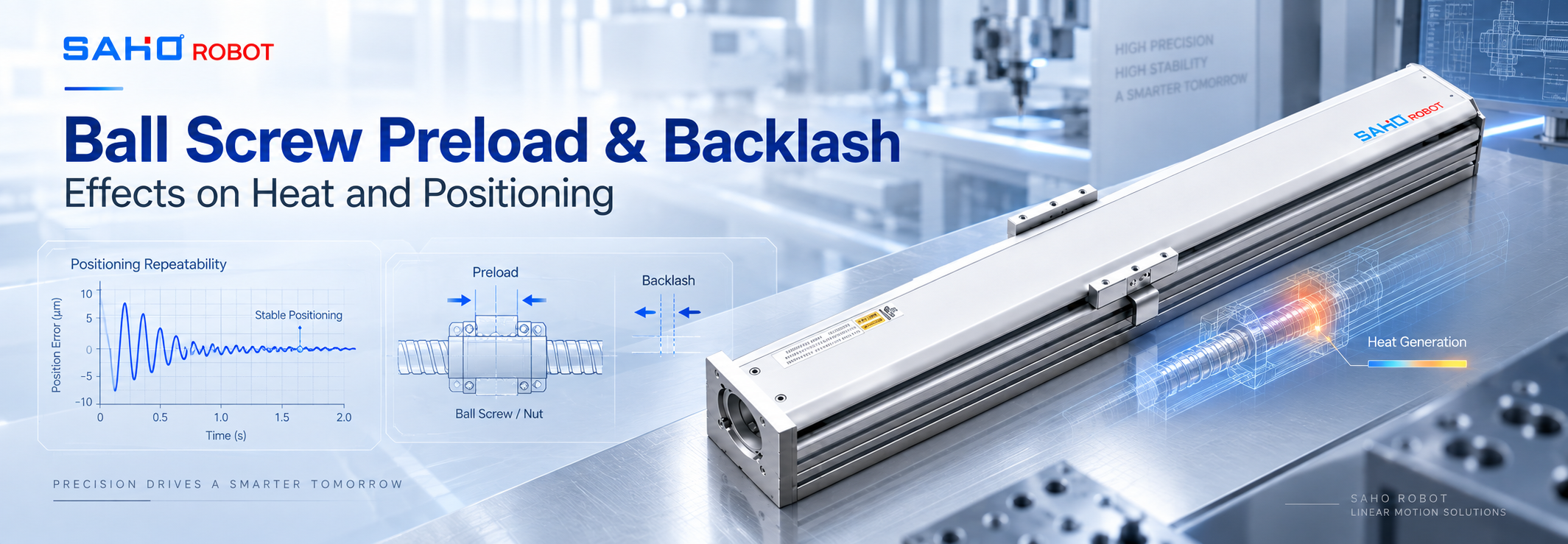
Ball screw preload and backlash are closely related, but increasing preload is not a universal solution for positioning error. Preload can reduce internal axial clearance and therefore reduce clearance-related lost motion during direction reversal. The tradeoff is higher internal contact force, which raises friction torque and can increase ball screw heat generation. As temperature rises, thermal expansion can introduce position drift. For machine builders, the practical task is to determine whether a reversal problem comes from axial clearance, elastic deformation, thermal behavior, mounting conditions, or the control and feedback system before changing the mechanical configuration.
Engineering rule: preload can reduce internal axial clearance and increase the ball nut's axial stiffness, but it cannot correct compliance elsewhere in the axis. If the observed error is mainly caused by support-bearing or mounting deflection, misalignment, lubrication, thermal drift, or control behavior, increasing preload may add friction and heat without solving the underlying problem.
Preload Reduces Axial Clearance, but It Also Adds Friction
Ball screw backlash is the relative axial movement that can occur before the screw-nut system fully transfers motion after the load direction changes. In a complete linear axis, it often appears as lost motion: the drive begins reversing, but the carriage does not immediately produce the corresponding output displacement.
Ball screw preload reduces this internal axial clearance by maintaining contact within the ball-and-raceway system. The exact way preload is created depends on the screw and nut design, which is why a preload class or arrangement should not be assumed from another ball screw.
The basic relationship is:
Higher effective preload → lower internal axial clearance → less clearance-related reversal motion
The same preload also increases internal contact force. The balls continue rolling through those loaded contacts during operation, so friction torque normally rises as preload rises. Depending on speed, duty cycle, lubrication, alignment, external load, and heat dissipation, that additional friction can produce a higher operating temperature.
Common mistake: a measured reversal deviation does not prove that the screw needs more preload. Support bearings, couplings, nut mounting, tooling plates, actuator mounts, and the machine frame can all contribute movement that looks like backlash at the final process point.
Separate Backlash, Elastic Deformation, and Control Error
A reversal error does not identify its own cause. Backlash, elastic deformation, and control behavior can create similar symptoms, but the corrective actions are different.
Backlash and axial clearance
Clearance creates mechanical lost motion as the contact condition changes from one direction to the other. The motor or screw can start moving before the carriage produces the same displacement. Appropriate preload is intended to reduce this clearance-related component.
Elastic deformation
Elastic deformation is load-dependent rather than free clearance. The screw, support bearings, coupling, nut connection, actuator mounting, tooling, and machine frame can all deflect under force. When thrust reverses, those components unload and then deform in the opposite direction.
Control and feedback behavior
Servo response, feedback location, command processing, and settling behavior add another layer. Motor-side feedback confirms motor movement, but it does not independently prove that every mechanical element between the motor and carriage moved without lost motion or compliance.
Useful diagnostic pattern: if the error changes mainly with direction, investigate lost motion. If it changes mainly with load, investigate compliance. If it changes mainly with operating time or temperature, investigate thermal behavior. More than one mechanism can be present at the same time.
For a broader axis-level review beyond preload and clearance, see the related guide on ball screw actuator accuracy checks.
How Ball Screw Preload Affects Heat
Understanding how ball screw preload affects heat starts at the loaded ball-raceway contacts. Preload keeps those contacts engaged even when external axial force is low. This reduces free axial movement, but the balls continuously roll through contacts carrying the preload.
As internal contact force increases, friction torque normally increases as well. Part of the mechanical input is therefore dissipated through friction. The resulting temperature rise depends on the complete operating condition rather than preload alone.
rotational speed and motion profile;
operating duty cycle;
preload and screw-nut construction;
lubrication type, quantity, and condition;
external axial load;
mounting alignment and support-bearing condition;
heat transfer into the actuator and surrounding machine structure.
Illustrative friction-loss example
Friction-related mechanical power can be expressed as:
P = T × ω
As an illustrative example, suppose friction torque rises from 0.20 N·m to 0.32 N·m while a screw rotates at 1,200 rpm. Angular speed is approximately 125.7 rad/s. The friction-related mechanical power changes from about 25 W to about 40 W, an increase of roughly 15 W.
Illustrative example only: these values are not SAHO product data, temperature limits, or acceptance criteria. The calculation estimates the change in friction-related mechanical power; it does not predict actuator temperature rise. Actual temperature depends on where heat is generated, how it is conducted and dissipated, lubrication, machine structure, ambient conditions, and operating time.
This is why a machine may position acceptably when cold but gradually shift after repeated cycling. The change is not automatically new backlash. Higher friction can increase temperature, and thermal expansion can move the physical position of the axis while the underlying axial clearance remains similar.
Possible symptoms of excessive ball screw preload include higher running torque, increased motor current under comparable conditions, faster temperature rise, or increasing thermal sensitivity during operation. None of these symptoms proves excessive preload by itself. Misalignment, lubrication problems, bearing drag, or another source of mechanical resistance can produce similar evidence.
Use Reversal Testing to Identify the Error Pattern
Ball screw backlash and positioning error become easier to separate when an axis repeatedly approaches the same reference position from opposite directions. If the final physical position consistently depends on the direction of approach, the system has a reversal-related error. Axial clearance may contribute, but compliance elsewhere in the axis can appear in the same measurement.
Positioning repeatability is a separate concept. Backlash describes a mechanical lost-motion mechanism. Repeatability describes how consistently the axis returns to the same position under defined conditions. An axis can have a stable directional offset and still repeat that offset consistently. It can also have little clearance-related backlash but inconsistent repeatability because temperature or load changes from cycle to cycle.
A practical bidirectional measurement sequence
Choose one physical reference position within the normal working range.
Approach the reference from one direction using a controlled, repeatable motion condition.
Record the actual carriage or tool-point position with independent measurement where practical.
Move away, then approach the same reference from the opposite direction using the same speed and load condition.
Repeat several cycles instead of judging the system from one reversal.
Repeat the sequence after normal operation has changed the thermal condition.
Record direction, load, temperature, operating time, and measured position together.
What the test should reveal: a stable direction-dependent gap points toward repeatable lost motion; an error that increases with load points toward compliance; a mean position that changes as temperature changes points toward thermal behavior. If both the reversal gap and mean position change, several mechanisms may be interacting.
Diagnose Heat, Lost Motion, and Inconsistent Reversal Before Changing Preload
The objective of troubleshooting is to find which physical variable changes with the symptom. The following table provides a practical path from observation to the next useful check.
| Observed behavior | Mechanism to investigate | Useful next check |
|---|---|---|
| Similar offset whenever approach direction changes | Axial clearance or other repeatable mechanical lost motion | Measure actual output displacement during slow bidirectional reversal. |
| Reversal error increases as axial load increases | Elastic deformation in the drive, supports, mounting, or structure | Repeat the measurement under controlled load conditions. |
| Mean position gradually shifts after repeated operation | Temperature rise and thermal expansion | Record position and temperature from cold start through the normal duty cycle. |
| Running torque or motor current is unexpectedly high | Internal friction, preload, alignment, lubrication, or bearing drag | Check alignment, lubrication, and mechanical resistance before changing preload. |
| Reversal results vary substantially between otherwise similar cycles | Changing load, temperature, mechanical condition, or control response | Log direction, load, temperature, operating time, and physical position together. |
| Motor feedback changes before measurable carriage movement | Lost motion or compliance downstream of the feedback point | Compare motor-side feedback with an independent output-position measurement. |
Do not adjust several variables at once. If preload, lubrication, servo parameters, and mounting are all changed before the axis is retested, the final result may improve without revealing which change solved the problem. That makes the next machine or the next recurrence much harder to diagnose.
What to Measure Before an SDM Application Review
Once the symptom has been classified, the discussion can move from troubleshooting to actuator configuration. Changing preload without sufficient evidence can trade one problem for another: more preload may reduce clearance while increasing friction and thermal sensitivity, while less preload may reduce friction but allow more axial clearance.
The SDM ball screw linear actuator is the relevant SAHO product direction when the machine requires a complete ball-screw-driven linear axis. It should be reviewed after the real reversal behavior, operating duty, load condition, mounting arrangement, and positioning requirement are understood. The final model and preload-related configuration should not be selected from backlash alone.
| Prepare these data before requesting a configuration review | |
| ✓ Commanded and measured output position | ✓ Direction of approach |
| ✓ Reversal-error magnitude and consistency | ✓ Complete moving load and process force |
| ✓ Cold and warm position measurements | ✓ Temperature readings at consistent locations |
| ✓ Motion profile and duty cycle | ✓ Torque or motor-current trend where available |
| ✓ Lubrication condition and maintenance history | ✓ Mounting alignment, coupling, and support condition |
| ✓ Required positioning repeatability | ✓ Known actuator or ball screw configuration |
This information turns a vague request such as “reduce backlash” into an engineering question that can be reviewed. The evidence may indicate that a tighter mechanical configuration deserves consideration, but it may instead point toward mounting alignment, lubrication, support conditions, structural compliance, or the control system.
Selection boundary: use the SDM product page to review the relevant screw-driven actuator direction, not to infer an unlisted preload value. For SDM-specific preload class, allowable temperature rise, backlash limit, or application acceptance criterion, engineering confirmation required.
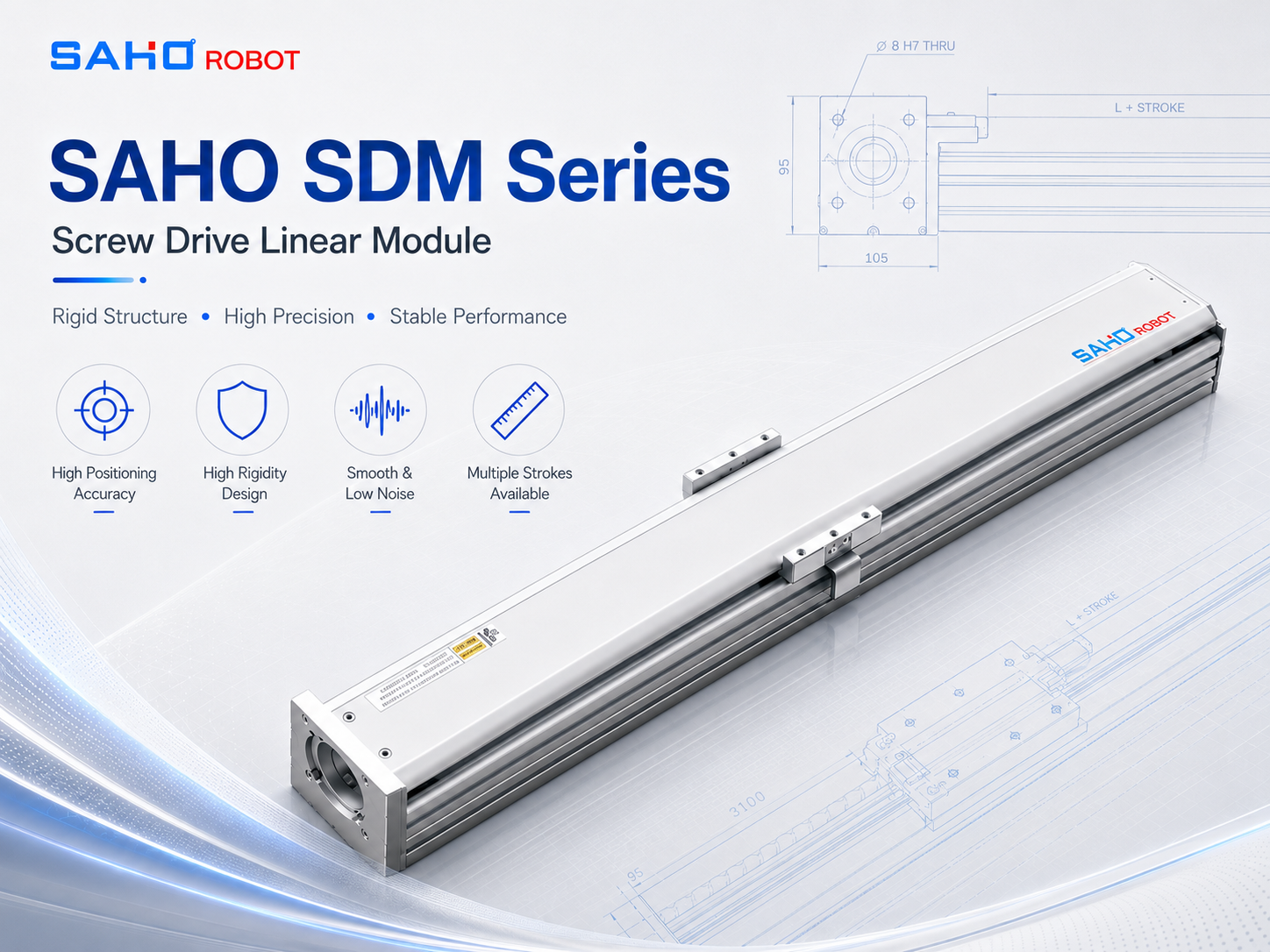 SDM Series Ball Screw Linear Actuator Review the SDM Series when the application calls for a complete screw-driven linear axis and the load, motion profile, mounting condition, duty cycle, and required repeatability are already defined. Final model and mechanical configuration still depend on the actual machine conditions. View SDM Series |
Frequently Asked Questions
| Does preload eliminate all positioning error? |
| No. Preload can reduce internal axial clearance and clearance-related lost motion, but positioning error can also come from elastic deformation, thermal expansion, mounting conditions, feedback location, and control behavior. |
| Can too much preload cause overheating? |
| Excessive preload can increase internal contact force and friction torque, which can contribute to higher heat generation. Misalignment, lubrication conditions, bearing drag, speed, and duty cycle can create similar symptoms, so the cause should be verified before changing preload. |
| How is backlash different from repeatability? |
| Backlash is mechanical lost motion associated with clearance and reversal. Repeatability describes how consistently an axis returns to the same position under defined conditions. A directional offset can be repeatable, while an axis with little backlash can still show poor repeatability when load or temperature changes. |
| What should be measured before blaming the ball screw? |
| Measure physical output position during bidirectional moves and record approach direction, load, operating time, temperature, and duty cycle. Where practical, compare motor feedback with an independent carriage measurement and check mounting alignment, lubrication, coupling, and support conditions. |
Move from the Symptom to an Engineering Review
The decision should follow the measured behavior. If reversal testing points toward clearance, confirm the actual screw and preload arrangement. If the error changes with load, review stiffness and mounting. If the position changes as the machine warms, include temperature and duty-cycle data before requesting a mechanical change.
In other words, ball screw preload and backlash should be reviewed as one part of a larger cause-and-effect chain: preload changes contact and axial clearance, contact affects friction torque, friction contributes to heat, and both mechanical lost motion and thermal expansion can affect the final position.
Prepare before contacting SAHO: reversal measurements, cold and warm position results, temperature readings, complete moving load, process force, motion profile, duty cycle, mounting orientation, lubrication condition, known actuator configuration, and required positioning repeatability. These data give the engineering review a clearer basis for deciding what needs to be checked next.
Review the SDM product direction first, then send the measured reversal behavior and application conditions together for engineering review. Review SDM Ball Screw Actuator Options Contact SAHO for Engineering Review |