

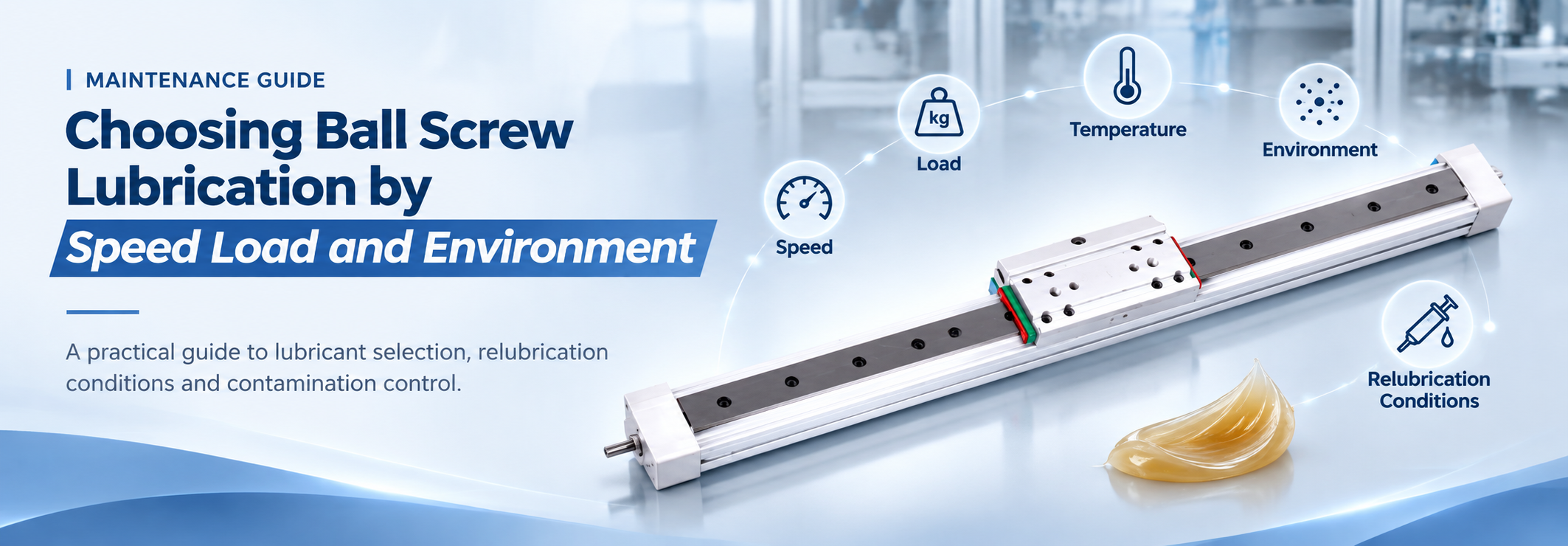
| Choosing lubrication for an electric linear actuator with ball screw begins with the manufacturer's approved lubricant and the conditions in which the axis actually operates. Speed, load, temperature and contamination determine whether the existing grease and relubrication plan remain appropriate. There is no reliable universal grease grade or refill interval that replaces the specification for the particular assembly. |
| 01 | Operating dutyRecord speed, load and stroke pattern. |
| 02 | EnvironmentCheck temperature and contamination. |
| 03 | Approved greaseVerify grease compatibility and delivery instructions. |
| 04 | Service evidenceDefine relubrication triggers and service access. |
Choose lubrication from the verified operating conditions
Ball screw lubrication starts with the method specified for the assembly. Oil-fed systems and grease-lubricated assemblies have different delivery and maintenance requirements, so they should not be treated as interchangeable. Where grease is specified, the next question is whether the approved lubricant and replenishment method remain suitable for the actual speed, load, temperature and exposure. Higher rotational speed can affect operating heat and grease distribution, while heavier loading places greater demands on the lubricant film. These factors need to be assessed together rather than used to select a grease grade in isolation.
For equipment already in service, begin with its original maintenance instructions. Confirm the factory lubricant, approved replenishment material, application point and procedure before comparing alternatives. A grease with an apparently suitable viscosity or consistency is not automatically compatible with the existing fill or the materials in the assembly.
For a new machine, lubrication should be considered alongside speed, load and machine layout rather than addressed after installation. If the SR Series ball screw linear module is being considered, use the selected model's drawings and maintenance instructions to confirm the approved lubricant, service points and access requirements.
Record speed, load, temperature and exposure
A nominal machine speed says little about what the ball screw experiences throughout a shift. Record screw rotational speed where known, linear travel speed, acceleration, applied load and mounting direction. Include the real operating temperature near the mechanism rather than assuming workshop ambient temperature represents the conditions inside a crowded machine enclosure.
Duty pattern: long travel is not the same as repeated short strokes
Two axes may accumulate the same daily travel but distribute it differently. One performs long moves with idle periods; another repeatedly reverses over a small part of the screw. That difference can affect how lubricant is distributed, which contact areas carry repeated load and how operating heat develops. The maintenance record should distinguish these patterns rather than describing both machines as running for the same number of hours.
If screw rpm is missing from the machine data, establish it from the actual screw lead, linear speed and transmission arrangement. SAHO's earlier article on ball screw lead and speed calculation explains that motion relationship. The calculated speed helps describe the duty; it does not determine a grease grade or service interval.
Contamination and cleaning conditions
Dust, fine particles, coolant mist and cleaning chemicals do not create identical risks. Some materials can contaminate exposed grease; cleaning fluid may reach the screw through openings that remain dry during ordinary production. A change from manual wiping to spray cleaning therefore deserves review even if speed and load are unchanged.
Document the substance, its likely entry path, how often exposure occurs and whether the protective arrangement remains intact. Avoid interpreting a cover or product-series description as proof of a particular sealing performance. That must be confirmed for the installed configuration.
Check lubricant and seal compatibility
Grease selection involves several properties that are easy to confuse. Base-oil viscosity affects lubrication behavior; grease consistency describes a different characteristic related to how the material behaves and can be delivered. Thickener chemistry, additives and operating-temperature limits also matter. Matching only the consistency grade is not sufficient evidence for a replacement.
Grease compatibility becomes especially important when an actuator already contains lubricant. Products that look similar on a datasheet may not be suitable for mixing. If the existing grease is unidentified, introducing a new product can create uncertainty rather than solve a maintenance issue. Obtain the approved changeover procedure and follow its instructions for removal or replenishment instead of improvising a flush.
| Before changing grease: confirm the existing product, the proposed replacement, compatibility evidence, seal-material suitability and the manufacturer's approved supply method. If any of these are unknown, the replacement remains subject to engineering confirmation. |
The seals, lubrication passages and fittings should be considered with the grease itself. An approved lubricant may still be delivered incorrectly if the application point, quantity or pressure differs from the specified method. More grease is not inherently better, and adding lubricant cannot compensate for damaged protection or contamination entering the mechanism.
Define relubrication triggers and inspection evidence
Relubrication conditions should reflect the manufacturer's maintenance basis and the way the machine actually runs. A calendar date may be convenient for scheduling, but elapsed time alone does not tell whether the axis has been idle, moving continuously or operating under more demanding exposure than originally specified.
Where the applicable maintenance instructions use accumulated travel, the machine's cycle record can help calculate it. For complete out-and-back cycles with a consistent stroke length within each recorded group, the total is D = Σ (2 × si × Ni), where D is total linear travel in metres, si is one-way stroke in metres, and Ni is the number of complete cycles in group i. For partial strokes or mixed movement, use actual recorded travel instead. This is a travel calculation, not a manufacturer-approved relubrication interval.
A maintenance record becomes more useful when it connects an observed change to the document that governs the decision. The matrix below can be kept with the machine's duty record so that a process change does not silently invalidate an older lubrication plan.
| Operating condition → Lubrication requirement → Evidence → Review trigger | |
| Speed & duty | Check: suitability for rpm, reversals and operating pattern. Source: model lubrication instructions and cycle record. Recheck: changed speed, stroke or duty cycle. |
| Load & temperature | Check: lubricant behavior under actual operating conditions. Source: model documentation and approved lubricant data. Recheck: changed load or thermal conditions. |
| Contamination | Check: grease exposure and protective-material compatibility. Source: cleaning-agent data, exposure record and approved specifications. Recheck: new cleaning or production process. |
| Existing grease | Check: replenishment or replacement compatibility. Source: factory-fill record and approved changeover method. Recheck: lubricant identity or supply product changes. |
| Service access | Check: application point, quantity and clean servicing method. Source: assembly drawing and maintenance instructions. Recheck: changed covers, machine layout or supply arrangement. |
This matrix is a way to organize a review, not a substitute for the original lubrication specification. The relevant manual must still define whether service is due by time, operating hours, travel or another approved condition, as well as how much grease is required.
Inspection evidence can include visible contamination, lubricant condition where inspection is permitted, leakage, service history and unexpected changes in motion. Noise, increased resistance or rising motor current can justify a broader mechanical investigation, but none proves that insufficient grease is the sole cause.
Plan access before the axis is installed
A well-defined relubrication plan is of little use when a machine frame or neighboring axis blocks the point that technicians need to reach. Access that looks straightforward on a standalone actuator can become difficult after covers, cable carriers and surrounding equipment are installed.
The SR/SRW screw-module structure shown below gives a useful reference for reviewing the physical layout around the rail and carriage. The image does not identify an approved grease point or service procedure. Those details must be taken from the drawing and maintenance documents for the selected model.
SR SERIES BALL SCREW MODULE SR Series European Standard Ball Screw Linear ModuleThe SR/SRW assembly view is useful for planning clearance around the rail, carriage and surrounding machine structure.
SR/SRW product image. Confirm the actual lubrication point and servicing access from the approved SR drawing. Review the SR range when application data and the machine layout are ready. Final grease selection and service access must be confirmed for the exact configuration. |

Review the servicing route in the final machine layout: can the specified equipment reach the intended point, can covers be removed safely, and can contamination be kept away from exposed components during maintenance? An extended grease line is not automatically an acceptable solution; its fittings and delivery conditions also need approval for the actual assembly.
Where a different integration arrangement is being considered, it may also be useful to review SDM options against your application data. Compare the respective model drawings, available servicing access and confirmed lubrication procedures. Do not assume the SR and SDM Series share a grease specification or replenishment schedule.
Request the SR lubrication specification
For a ball-screw-driven linear actuator, the lubricant and service plan should be confirmed for the exact assembly rather than selected from a generic grease recommendation. An SR inquiry should identify the selected or proposed configuration, operating speed and load, stroke pattern, temperature, exposure conditions, existing grease where applicable and expected service access.
Ask SAHO to confirm the factory lubricant, approved replenishment or alternative product, application method, quantity, compatible materials and the conditions that require relubrication or another review. Those answers give maintenance teams a workable plan and procurement teams a defined specification to use when sourcing supplies.
If the machine has begun making unusual noise or vibrating, investigate the full mechanical and motion system rather than assuming a grease change will correct the problem. A lubrication plan is one part of reliable servicing, not a universal remedy for mechanical faults.
Frequently Asked Questions
| Can different greases be mixed? |
| Only when their compatibility and the manufacturer's approval have been established. Similar consistency grades do not prove that two greases can be safely mixed. |
| Is a calendar interval sufficient for every duty cycle? |
| No. Machine use, accumulated travel and environmental exposure may differ greatly between installations. Apply the maintenance basis specified for the actual assembly. |
| Should lubricant be changed after cleaning-process changes? |
| Not automatically. Assess new chemicals, moisture exposure and ingress paths first. Change the lubricant or protection arrangement only when supported by the approved review. |
| What information is needed before selecting a grease? |
| The exact assembly, factory lubricant, speed, load, duty cycle, temperature, contamination, service method and applicable manufacturer documentation. |
Review SR Series with Your Application Data Bring the operating-condition matrix, proposed model or drawing, existing grease details and the machine's speed, load, temperature and exposure records. Use them to confirm the applicable SR lubrication requirements before approving a product or service plan. |