

Date:2026-07-23 Click:272
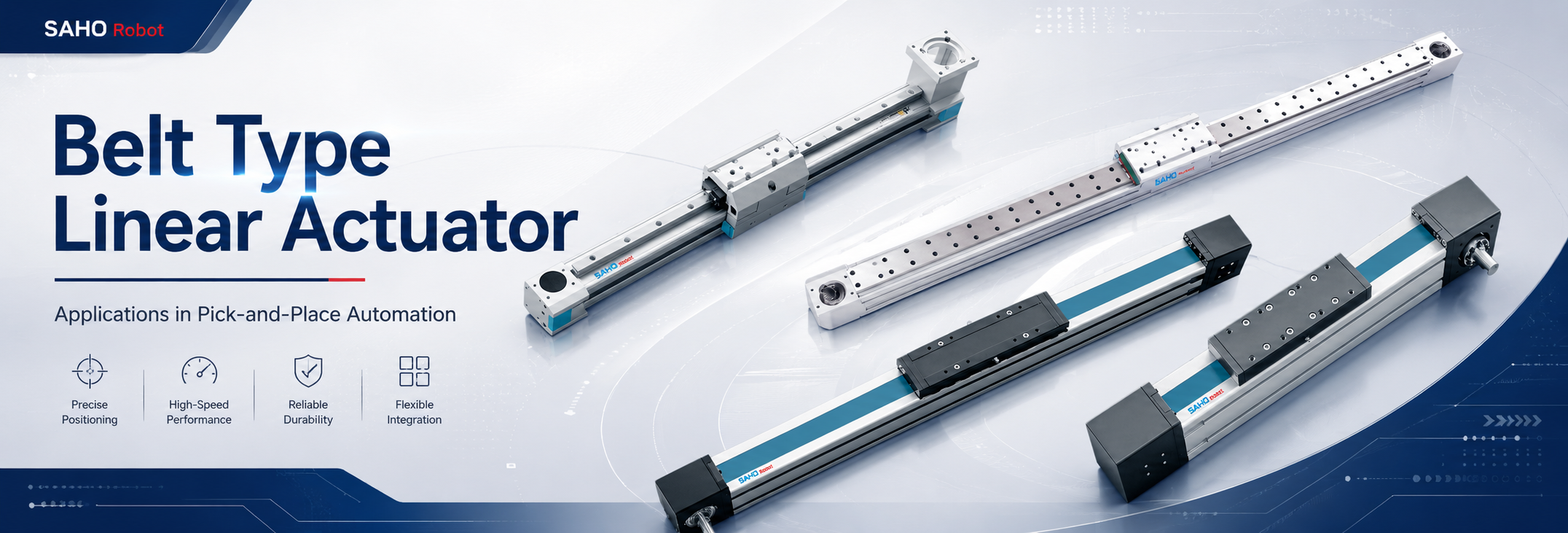
In pick-and-place automation, a Belt Type Linear Actuator supports fast horizontal transfer, smooth repeated motion, and long-stroke handling between workstations. Strong motion performance is not only about speed. A stable axis must shorten cycle time, carry the real moving load, and stop without disturbing the part.
Actuator selection should follow the real process. Stroke, acceleration, payload center, duty cycle, installation direction, guide support, and clean-room demand all affect the final result. This article focuses on pick-and-place application logic, cycle-time planning, load matching, stroke selection, and SAHO belt-drive module direction rather than a simple top-speed comparison.
| Application Need | Main Motion Challenge | SAHO Product Direction |
| General pick-and-place transfer | Long stroke, acceleration, and smooth stop | TA Series |
| Clean-room handling | Covered structure and stable low-noise transfer | MTG Series |
| Compact machine layout | Space-saving Euro standard belt module installation | TR Series |
| Special-environment transfer | Protected structure and repeated transfer motion | JTG Series as a related option |
Why Pick-and-Place Automation Needs a Matched Belt Axis
Pick-and-place equipment repeats the same motion many times during production. The movement is rarely just a straight trip from one point to another. The axis must accelerate, carry the load, decelerate, settle, and return without adding vibration to the process.
A good actuator choice must support the full motion sequence. The gripper, suction cup, bracket, cable chain, air tube, sensor, and workpiece all become part of the moving mass. The position of that mass also changes the moment load on the carriage.
Belt-driven linear modules are useful in many machines because they handle long travel and fast transfer efficiently. The structure can remain easier to integrate than a more complex motion system. This is why belt modules are often used as the main horizontal axis in packaging, electronics, battery, photovoltaic, TFT-LCD, and general automation equipment.
How a Belt-Driven Linear Module Works in Pick-and-Place Motion
In a typical pick-and-place unit, the horizontal axis moves the tool between stations. A vertical axis lifts and lowers the gripper, suction head, or fixture. Because of this motion split, the horizontal module usually handles more travel distance and repeated acceleration.
At the pick point, the tool lowers, grips the part, and rises. The horizontal axis transfers the part to the place point. The vertical axis then lowers again and releases the part. Each step adds time, so the final cycle depends on the complete sequence.
Maximum speed alone does not define output. A machine with better acceleration, smoother deceleration, and shorter settling time may complete more stable cycles than a machine with only a higher top-speed number. Motion quality should be reviewed together with speed.
Key Benefits in Pick-and-Place Applications
Fast Transfer Over Useful Stroke Lengths
Belt-driven motion suits applications that require longer travel. The belt drive converts rotary servo motion into linear movement across a guided carriage. One axis can connect several stations without making the machine structure overly complicated.
In practical production lines, the stroke may need to cover feeding, inspection, assembly, rejection, or unloading areas. A short mechanism may not provide enough travel margin. A belt-driven module can support longer transfer while keeping the layout compact and serviceable.
Smooth Motion for Stable Product Handling
Smooth motion reduces the risk of part slip, bounce, or delayed settling. This matters when the tool uses vacuum cups, thin fingers, soft pads, or a light fixture. Smooth deceleration also helps the next operation start earlier because the end effector does not keep oscillating.
A light plastic part may move quickly but still shift if acceleration is too aggressive. A fragile electronic component may need gentler movement before placement. The actuator and controller should support a practical acceleration curve rather than a harsh stop-start profile.
Flexible Integration With Multi-Axis Systems
Belt modules can integrate into X-Z, X-Y, XYZ, and gantry structures. The horizontal axis may carry a vertical module, a rotary unit, a small inspection head, or a multi-cup vacuum tool. The selected model should be checked as part of the full moving assembly.
The base axis in a multi-axis system carries more mass than the top axis. This detail is easy to miss during early design. Model selection should include the complete moving stack, not only the payload at the tool tip.
Cycle Time: Where the Real Production Gain Comes From
Cycle time includes more than straight-line travel. It includes pick dwell, vertical lift, horizontal acceleration, travel, deceleration, settling, vertical drop, release, and return. The actuator must be selected for the whole process rhythm.
On short strokes, the axis may never reach its rated maximum speed. Acceleration and deceleration dominate the move. On longer strokes, the axis may spend more time at constant speed. Stroke length changes which selection factor matters most.
Settling time often decides whether the machine can run faster without errors. If the carriage stops but the tool keeps swinging, placement must wait. Smooth mechanical support and suitable motion tuning can improve output without increasing the rated speed.
| Cycle Section | Common Problem | Selection Focus |
| Pick dwell | Vacuum or gripper not fully stable | Tool design and lift timing |
| Acceleration | Part shifts or tool vibrates | Payload, moment load, and belt drive capacity |
| Travel | Long axis shakes at speed | Stroke, frame rigidity, and guide support |
| Deceleration | End effector swings before placing | Ramp setting, carriage stiffness, and load center |
| Settling | Placement accuracy changes | Mechanical stability and repeatability |
TA Series as the Main Direction for General High-Speed Transfer
The TA Series is the main SAHO reference direction for general high-speed silent belt transfer. It suits applications that need long stroke, efficient transfer, smooth operation, and practical cost performance. It fits many pick-and-place stations where a clean-room covered structure is not the main requirement.
In packaging lines, TA modules can support tray transfer, pouch handling, carton positioning, separator movement, and simple shuttle systems. In battery and photovoltaic equipment, the same product direction can support longer horizontal travel between process stations. TA works well as the main transfer axis in many industrial layouts.
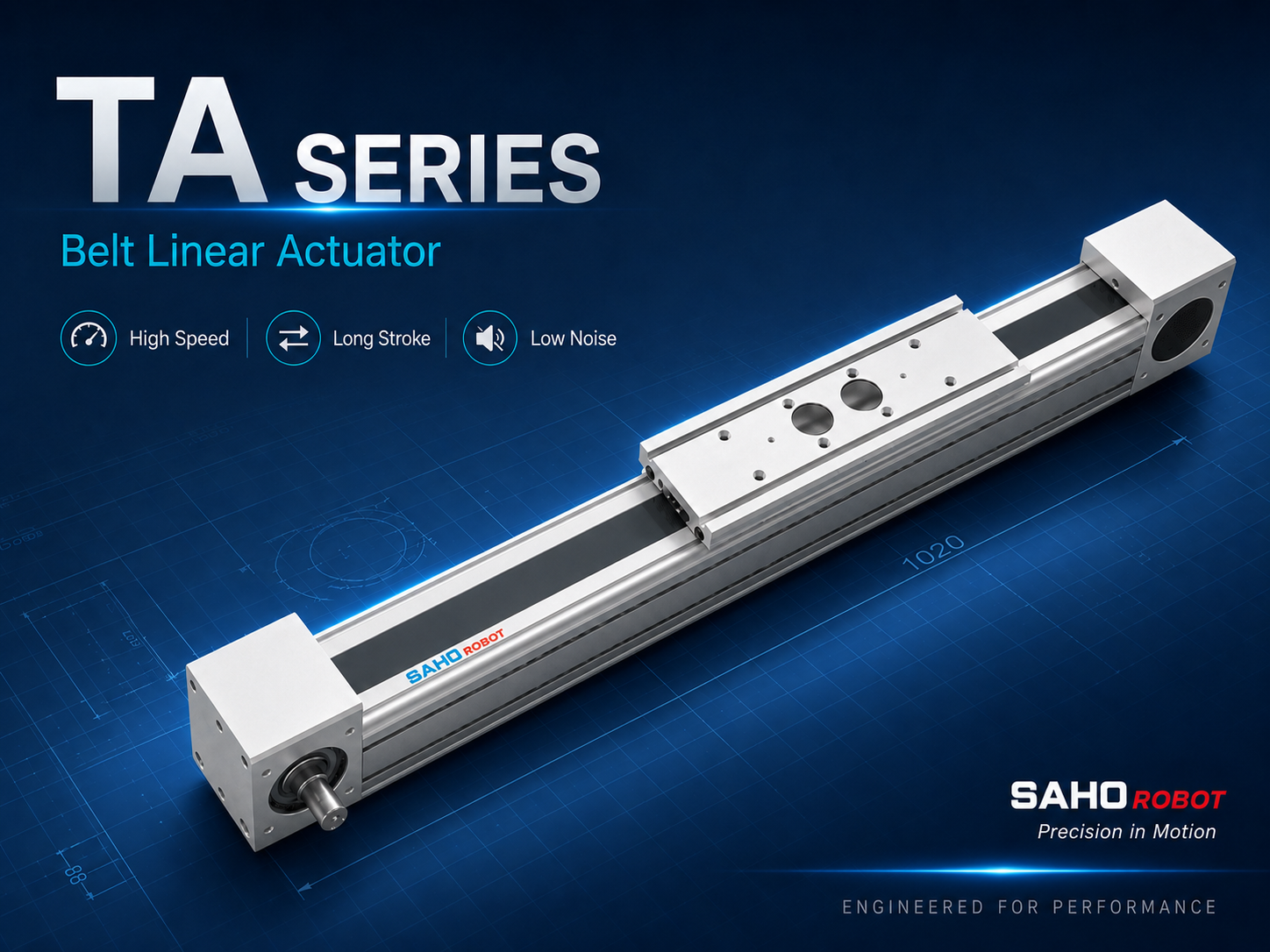
TA Series belt type linear actuator for general high-speed pick-and-place transfer, long-stroke handling, and smooth repeated motion.
For compact belt-module layouts, the TR Series can also be reviewed as a related Euro standard belt module option. It remains within the linear module belt-drive category and does not belong to the linear motor product family.
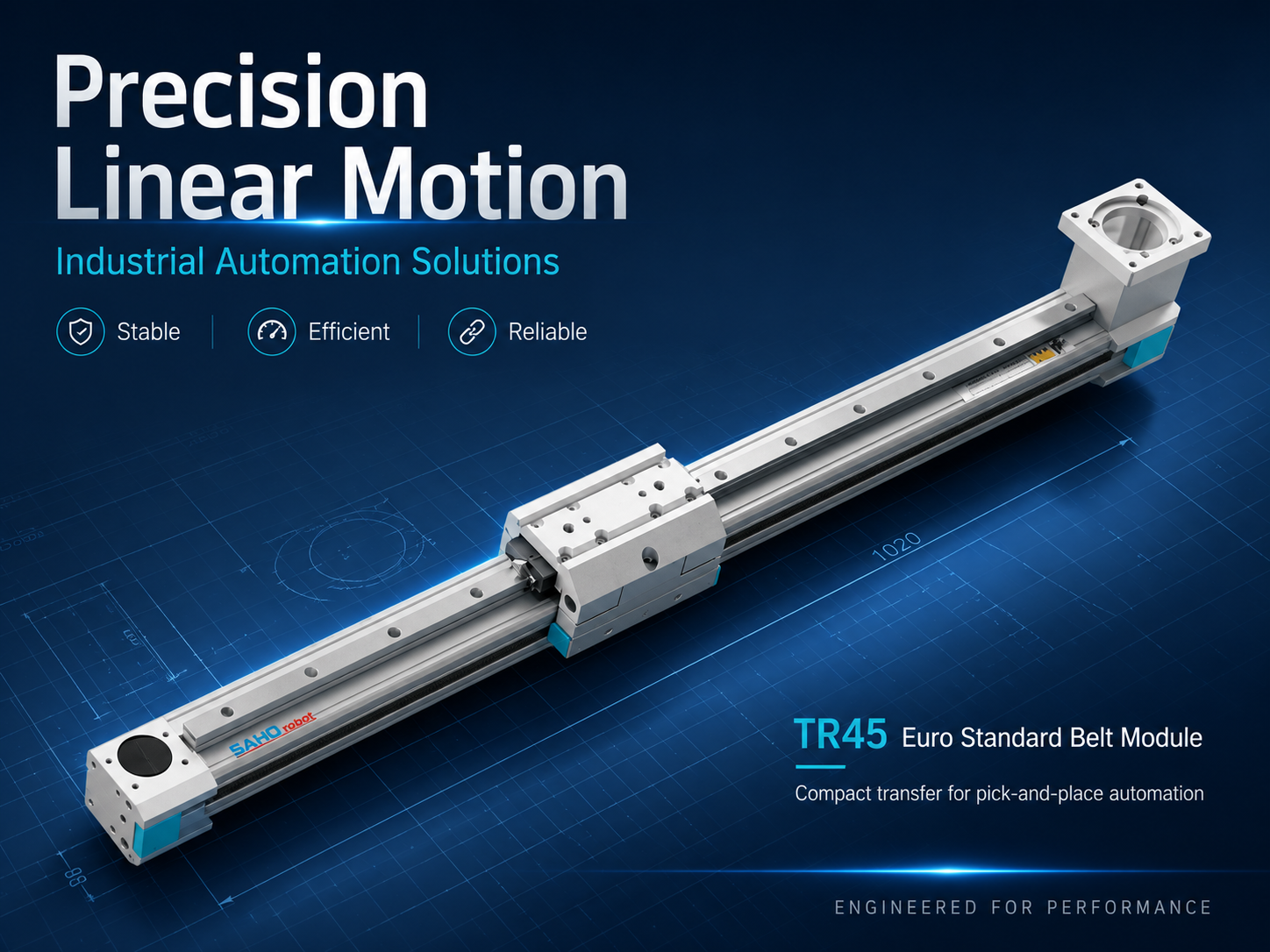
TR45 Euro standard belt module for compact transfer, feeder movement, and pick-and-place automation layouts.
Load Matching: The Payload Is More Than the Product Weight
A frequent selection mistake is checking only the workpiece weight. The actuator also carries the gripper, bracket, cable chain, sensors, air fittings, vacuum tubes, and any moving cover. The full moving mass must be calculated before choosing the model.
Moment load is equally important. A tool that hangs below the carriage or extends forward creates an offset load. During acceleration and deceleration, that offset increases stress on the guide and carriage. A larger module may be needed even when the part itself is light.
For light products, the design may focus on quick acceleration and short settling time. For heavier fixtures, the design may need a wider profile, lower acceleration, or stronger machine support. Reliable selection depends on real application data rather than a single payload number.
| Load Item | Why It Matters | Selection Action |
| Workpiece | Adds direct moving mass | Record maximum and minimum part weight |
| Gripper or vacuum tool | Can weigh more than the part | Include bracket and tooling weight |
| Cable chain and tubes | Adds drag and moving resistance | Include cable routing in the layout |
| Offset center | Creates moment load during motion | Share load center distance with SAHO |
Stroke Planning for Single-Axis and Multi-Station Transfer
Stroke planning should start from the real process route. The axis must cover the distance between pick and place points. Extra margin should be added for end clearance, safety distance, sensor mounting, fixture adjustment, and future product changes.
In a simple station, the stroke may only connect one feeder and one fixture. In a larger cell, one horizontal axis may serve several stations. The layout should consider the full production flow before locking the actuator length.
Longer stroke also increases the importance of frame support. A strong actuator cannot perform well on a weak base. The mounting surface should remain flat and rigid across the full travel range.
When a wider carriage or longer belt-module structure is needed, TR belt module options can be reviewed for long transfer layouts. Wider-support configurations should be confirmed based on tooling layout, load center, and stroke requirement.
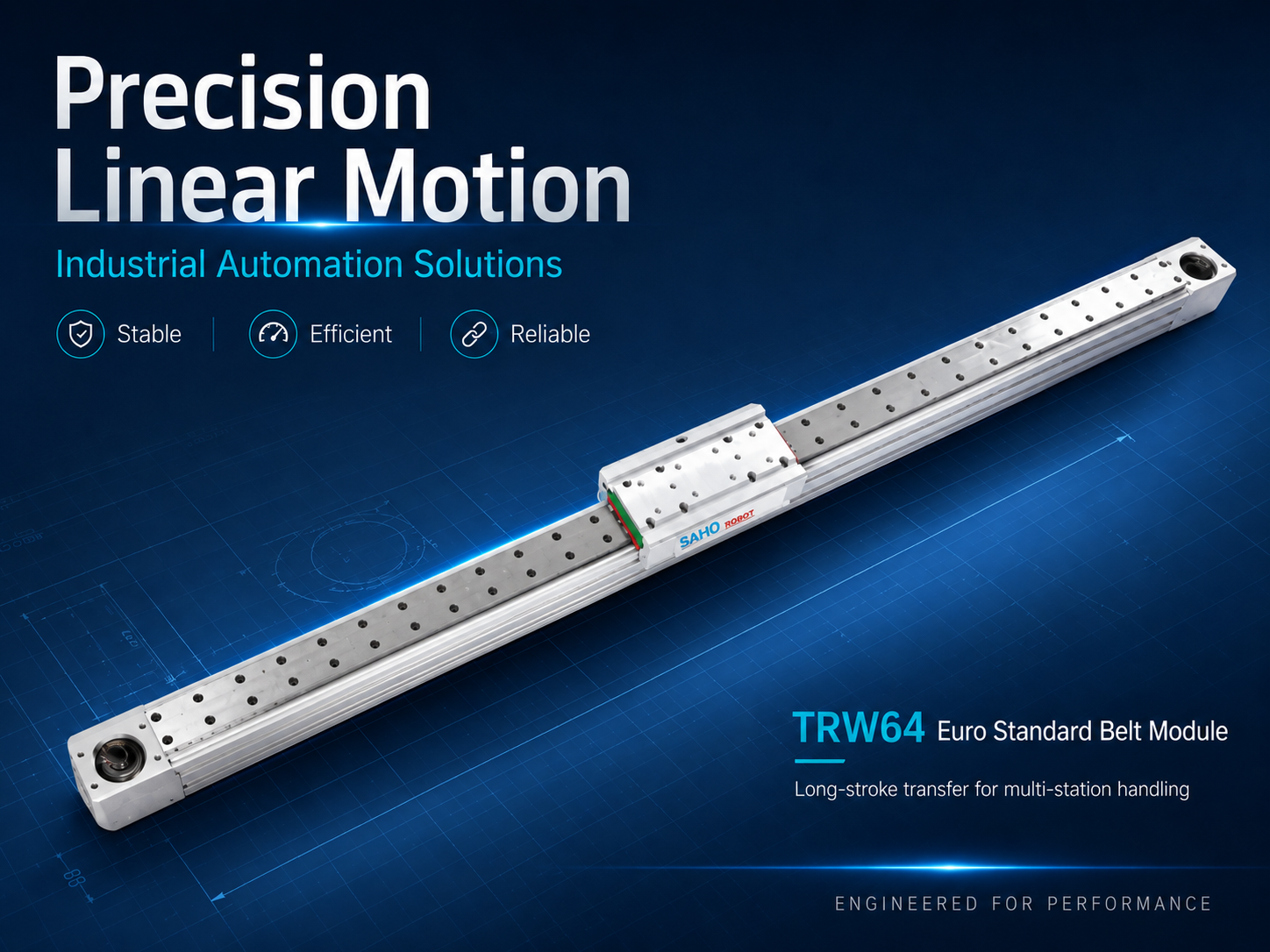
TR Series belt module options can support longer stroke transfer, wider carriage support, and multi-station handling systems when the layout requires it.
Smooth Transfer for Packaging, Electronics, Battery, and Photovoltaic Lines
Packaging Automation
In packaging automation, products often move between feeding, grouping, sealing, labeling, and unloading stations. The axis needs enough stroke and steady motion. A belt-driven module can support fast transfer without making the mechanical system too heavy.
Packaging parts may be light and easy to shift. Pouches, trays, and plastic parts can move inside the tool if acceleration is too aggressive. The best setting often uses a smooth ramp instead of the harshest possible start.
Electronic Component Assembly
In electronic component assembly, the axis may work near vision cameras, feeders, sensors, and inspection units. Vibration control matters because smoother transfer helps maintain part position before inspection or placement.
Space around feeders can be limited. Cable routing, sensor location, and bracket width should be checked early. This helps the final actuator installation fit the machine without forcing late layout changes.
Lithium Battery Production
In lithium battery production, a transfer axis may move trays, fixtures, cells, or small assemblies. The stroke can be long when the line connects several process positions. A belt-driven module can provide useful travel range for shuttle-type handling.
Battery-related tooling can include clamps, sensors, and protective plates, so the moving fixture may be heavier than expected. Full payload and moment load should be calculated before selecting the model.
Photovoltaic and TFT-LCD Handling
Photovoltaic and TFT-LCD handling often involves broad or delicate components. Because the tool may be wide, the load center can sit far from the carriage center. Guide stiffness and support structure become important.
Smooth deceleration helps protect fragile surfaces and maintain alignment. A fast but unstable axis can reduce yield, so transfer quality should be treated as part of process quality.
MTG Series for Clean-Room Pick-and-Place Environments
Some pick-and-place systems must run in cleaner production areas. Electronics, display, medical-related assembly, and precision component handling can require better control around moving parts. The MTG Series becomes the main SAHO direction when a clean-room style belt actuator is needed.
MTG uses a covered belt-driven structure for high-speed, long-stroke, and stable linear motion in automated equipment. It can be used as a single axis or integrated into X-Y, XYZ, and gantry linear robot structures. This makes it useful for cleaner transfer areas where both motion performance and process environment matter.
When a Clean-Room or Special-Environment Belt Module Is Needed
Clean-room selection is not only a product label. It depends on the process, the environment, and the complete machine structure. Exposed cables, open brackets, unsuitable lubrication, or dusty tooling can reduce the benefit of a covered axis.
The actuator should be selected together with the end effector and machine guarding. Air tubes, cable chains, sensors, vacuum fittings, and maintenance access should all support the cleaner operating goal. In this way, the motion axis becomes part of a complete clean transfer plan.
For special-environment belt-drive applications, the JTG Series can be considered as a related SAHO linear module option. It remains a belt-drive linear module, so it should not be confused with MK, NK, or other linear motor product families.
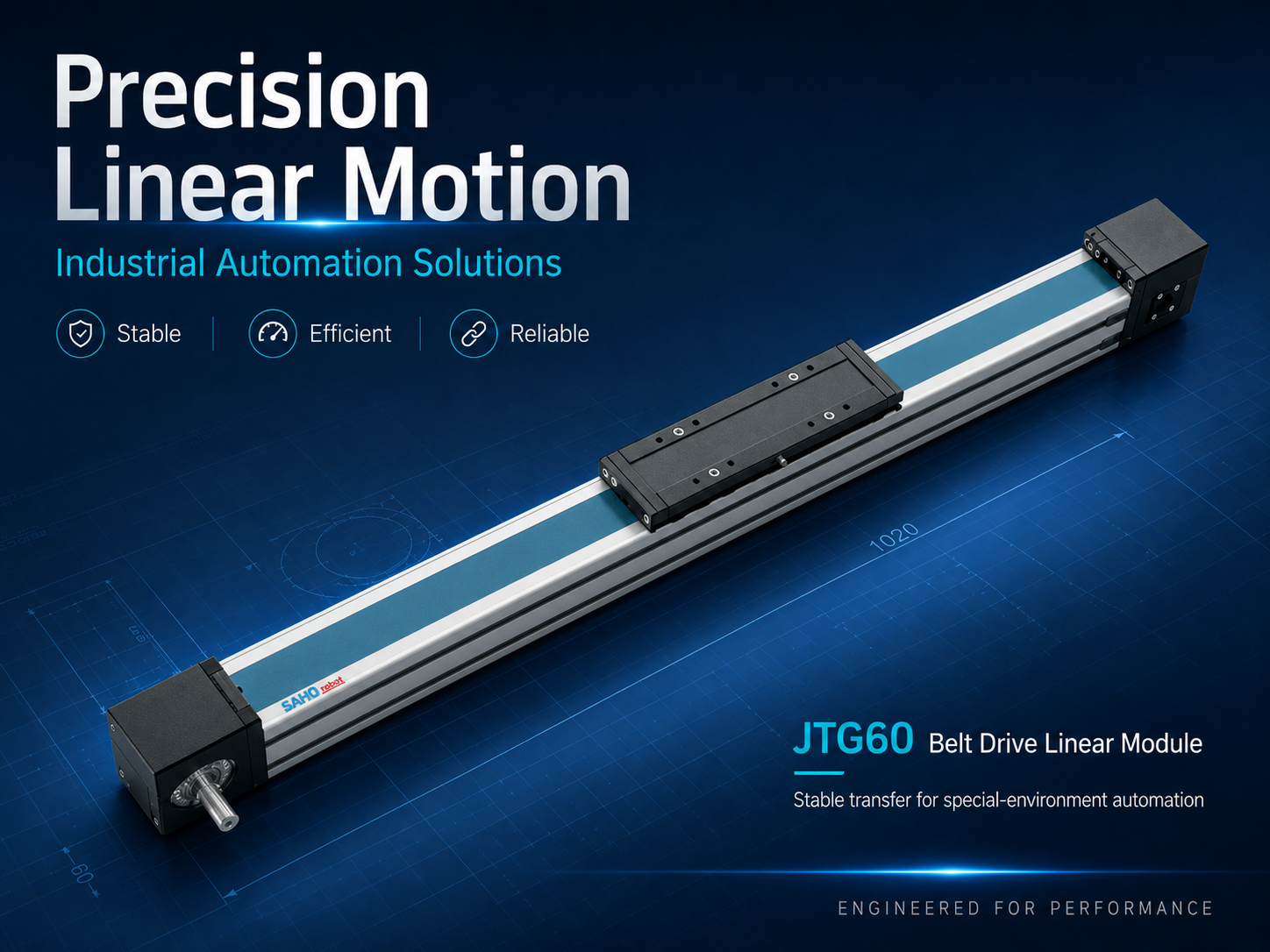
JTG60 belt drive linear module for special-environment handling, stable transfer, and repeated automation motion.
Common Pick-and-Place Layouts Using Belt Modules
X-Z Pick-and-Place Unit
An X-Z unit is one of the most common layouts. The X axis handles horizontal transfer, while the Z axis handles lifting and lowering. The horizontal module must carry the vertical axis, tooling, cables, and workpiece together.
This layout is suitable for feeder loading, tray transfer, light assembly, packaging movement, and simple machine tending. The moving vertical unit can create an offset load, so carriage size and guide support should be checked carefully.
X-Y Transfer Table
An X-Y transfer table allows movement across a larger work area. The lower axis carries the upper axis, so it faces higher load and higher moment stress. The lower axis usually needs stronger sizing than the top axis.
Cable routing becomes more important in X-Y systems. Drag from the cable chain can affect the moving mass and dynamic behavior. Cable path design should be included in early layout planning.
Gantry Transfer System
A gantry system can cover a wide process area and several workstations. It may use two parallel axes to move one beam. Synchronization, frame alignment, and beam stiffness become central design points.
If the parallel axes are not aligned, racking can appear during movement. This can reduce accuracy and increase mechanical stress. Gantry planning should include both actuator selection and machine frame design.
Selection Tips for Stroke, Load, Speed, and Accuracy
Define the actual stroke. The travel distance should include pick position, place position, tool clearance, sensor space, and safety margin. Without this allowance, the machine may run too close to the actuator end limit after later fixture changes.
Calculate the full moving load. The mass list should include the part, gripper, bracket, valve, cable chain, tube, sensor, and any moving fixture. The distance from the load center to the carriage center should also be recorded.
Define the cycle time with a real motion sequence. A complete cycle includes pick dwell, lift, transfer, settling, drop, release, and return. The selected actuator should match the full timing target, not only a single speed number.
Review repeatability and placement tolerance. Belt modules are commonly selected for high-speed and long-stroke transfer. Very high precision positioning may require another drive structure, so the accuracy requirement should be stated clearly before final selection.
| Selection Data | Recommended Detail | Reason |
| Stroke | Effective travel plus safety margin | Avoids end-limit problems after fixture changes |
| Load | Full moving mass and load center | Improves guide and motor matching |
| Speed and acceleration | Target cycle and motion profile | Prevents unstable high-speed operation |
| Accuracy | Repeatability and placement tolerance | Avoids over-selection or under-selection |
| Installation direction | Horizontal, side-mounted, vertical, or inverted | Changes load, moment, and safety needs |
| Environment | Dust level, clean-room need, duty cycle | Guides TA, MTG, TR, or JTG selection direction |
Installation Direction and Machine Frame Support
Installation direction changes the way the actuator carries load. A horizontal axis mainly handles moving mass and moment load. Vertical or inclined installation should be reviewed carefully because gravity affects holding behavior, belt load, and safety. A brake motor, mechanical lock, or another holding method may be required depending on the application.
For overhead pick-and-place layouts, frame rigidity becomes very important. If the frame bends during motion, the axis may not maintain stable positioning. The mounting base should be strong enough to support the full stroke.
Side mounting can save space, but it changes the load on the guide. A side-mounted axis with a long tool may create higher moment stress. Installation direction should be shared before model confirmation.
Maintenance access also matters. Belt tension inspection, guide lubrication, sensor adjustment, and cable replacement should remain possible after installation. The machine layout should leave enough service space around the actuator.
How to Choose Between TA, MTG, TR, and JTG Belt Module Options
TA Series and MTG Series remain the main product directions for this article. TA is suitable for general high-speed silent transfer. MTG is suitable when a clean-room style covered structure is required.
TR and JTG can be used as related belt-module references when the layout needs another structure, size range, or special-environment form. The first selection question should be about the working environment, stroke, payload, and installation space.
| Series | Product Direction | Best-Fit Pick-and-Place Use |
| TA Series | High-speed silent belt drive module | Long-stroke transfer, shuttle handling, packaging, battery, LCD, photovoltaic, and general automation |
| MTG Series | Clean-room belt driven actuator | Clean-room transfer, electronics assembly, TFT-LCD, precision handling, and gantry structures |
| TR Series | Euro standard belt module | Compact transfer, feeder movement, and modular pick-and-place stations |
| JTG Series | Special-environment belt module | Protected transfer, repeated motion, larger handling systems, and special-environment layouts |
Industry Background: Automation Lines Need Faster and More Stable Transfer
Automation equipment continues to require faster changeover, higher uptime, and more stable handling. The A3 Association for Advancing Automation provides industry resources across robotics, motion control, vision, and automation technologies. Actuator selection should be considered as part of the full automation system.
For pick-and-place systems, the axis must work with servo control, sensors, machine vision, grippers, safety devices, and line changeover needs. The best selection is not the fastest component alone. It is the axis that supports stable production over time.
Data Checklist Before Requesting Model Selection
A clear data sheet helps shorten the selection process. Record the required stroke, available installation space, and transfer direction. Add load data, including the full moving mass and load center.
Define the target cycle with the full motion sequence, including acceleration, travel, deceleration, dwell, and return. Note whether the actuator works continuously, intermittently, or in several shifts per day.
Describe the working environment before confirming the belt-drive module series. Dust, humidity, clean-room requirements, installation angle, cable routing, and motor preference all affect the final recommendation.
Stroke length and required effective travel.
Moving load, gripper weight, bracket weight, and load center distance.
Target speed, acceleration, cycle time, and duty cycle.
Repeatability requirement and placement tolerance.
Horizontal, side-mounted, vertical, or inverted installation direction.
Clean-room requirement, dust level, and maintenance access.
Servo motor brand, sensor position, and cable routing plan.
FAQ
What makes a belt-driven linear actuator suitable for pick-and-place?
A belt-driven linear actuator is suitable when the motion needs fast transfer, longer stroke, repeated movement, and smooth travel. It can support X-Z, X-Y, XYZ, and gantry layouts used in pick-and-place machines.
How should cycle time and payload be balanced?
Cycle time and payload should be balanced through the full motion sequence. The moving mass and load center should be calculated first. Acceleration, deceleration, settling time, and dwell time should then be reviewed together.
When is a clean-room belt actuator needed?
A clean-room belt actuator is needed when the process requires cleaner transfer around sensitive products, such as electronics assembly, TFT-LCD handling, precision component transfer, and medical-related automation. MTG Series can be reviewed when clean-room compatibility is part of the process requirement.
Which SAHO series is more suitable for general pick-and-place transfer?
For general high-speed and long-stroke transfer, TA Series is often the practical starting point. For cleaner environments, MTG Series should be reviewed first. For compact Euro standard belt-module layouts, TR can be considered. For special-environment belt-drive requirements, JTG can be reviewed as another related option.
What information should be sent to SAHO before model selection?
The selection request should include stroke, moving load, load center, speed, acceleration, cycle time, accuracy requirement, installation direction, working environment, motor brand, sensor position, cable route, and clean-room demand.
Conclusion and Practical Selection Advice
A strong pick-and-place system depends on more than actuator speed. The axis must match cycle time, acceleration, payload, stroke, installation direction, repeatability, and working environment. TA Series supports many general high-speed transfer layouts, while MTG Series supports clean-room style pick-and-place and precision handling lines. TR and JTG provide additional belt-module directions when the layout needs compact Euro standard structure or special-environment transfer.
Define the complete motion sequence, including pick dwell, lift, transfer, settling, drop, release, and return.
Calculate the full moving load, including tooling, cables, tubes, sensors, brackets, and load center distance.
Select the belt-drive module series according to stroke, speed, accuracy, installation direction, duty cycle, and clean-room need.
Contact SAHO for Pick-and-Place Axis SelectionFor Belt Type Linear Actuator selection, send SAHO the required stroke, moving load, payload center, speed, acceleration, cycle time, accuracy, installation direction, working environment, and clean-room requirement. SAHO engineers can recommend a suitable TA, MTG, TR, or JTG belt-drive linear module for the planned automation layout. |







-
-
 English
 -
 Français
 -
 Deutschland
 -
 Italia
 -
 Polska
 -
 España
 -
 Русский язык
 -
 日語
日語 -
 한국
한국 -
 Türkiye
 -
 português
 -
 بالعربيةês
 -
 Tiếng Việt
 -
 คนไทย
คนไทย -
 简体中文
简体中文 -
繁體中文
-